
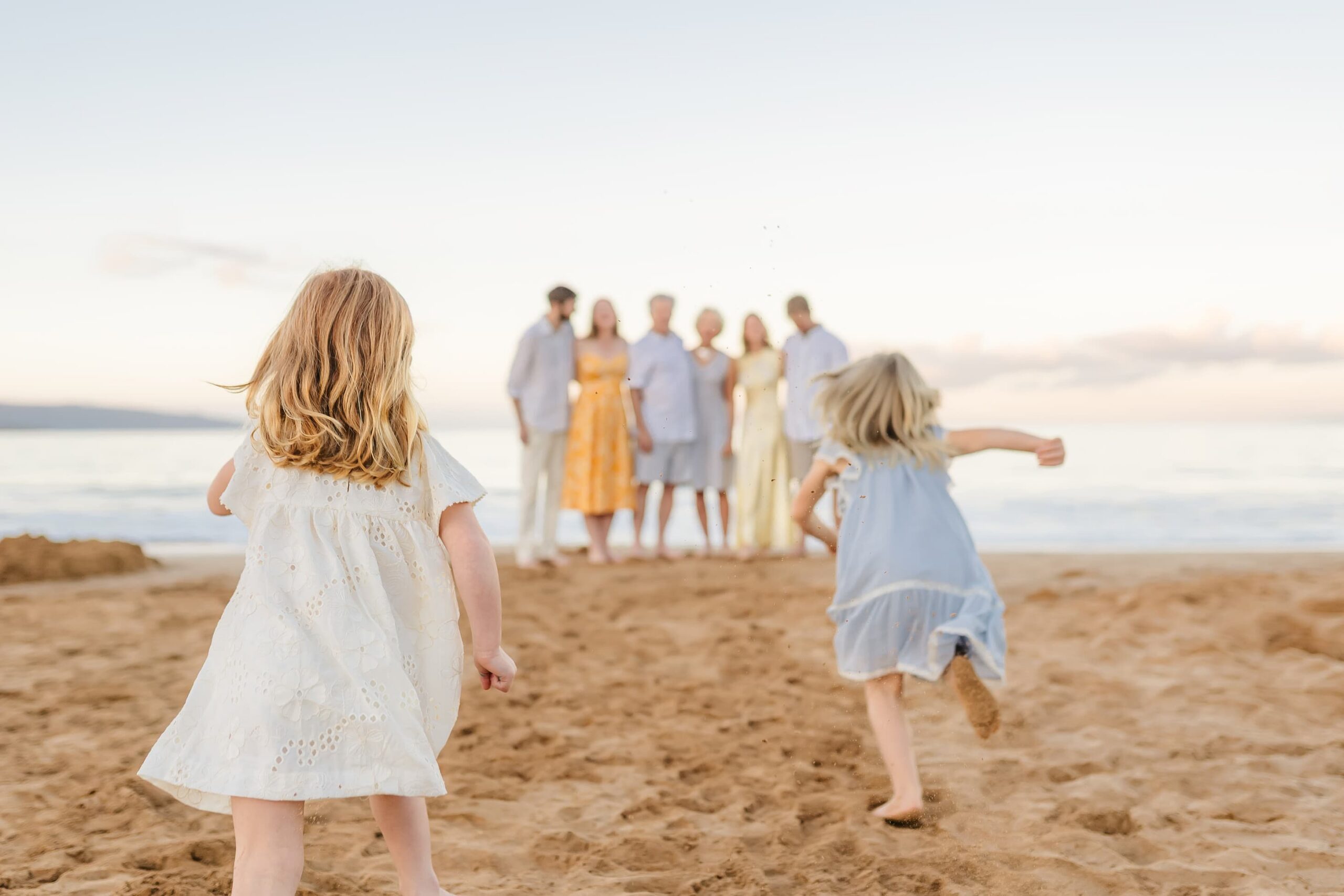

Hawaii photography permits: how to get a DLNR Wiki Permit (and when you need a film permit)
Yes, you need a permit to photograph in Hawaii if the shoot is commercial. That means you’re being paid, trading your work for something, or using the images to promote a business, and yes, your portfolio and your Instagram count. For most photographers working on Hawaii’s beaches, the simplest option is a DLNR Wiki Permit: $20 for up to two hours on one of about 240 listed state shorelines, bought online in a few minutes. Taking photos of your own family for your own memories doesn’t need a permit at all.
When I moved here and started photographing families on the Big Island in 2016, figuring this out was honestly overwhelming. The government websites were hard to navigate; there were two different offices issuing permits, and I couldn’t tell what each one covered or cost. I pieced it together one PDF at a time. Today our team photographs around 300 sessions a year on the Big Island, Maui and Oahu, and we pull a permit for every beach session. This is the guide I wish I’d had.
Before we dig in: I’m a photographer and a business owner, not a permit office. The state updates its rules and forms, so every section links to the official source. Please confirm the details with the agency before you book anything.
Hawaii photography permits at a glance
| Permit | Who issues it | Where it works | Cost | Lead time |
|---|---|---|---|---|
| DLNR Wiki Permit | DLNR Land Division | About 240 listed state beaches and shorelines | 10 cents per square foot, $20 minimum, up to 2 hours | Minutes, once your account is approved |
| Open & Accessible ePermit | Hawaii Film Office | State sites on the Open & Accessible list | $10 per two-week period | Insurance review takes 1 to 3 business days |
| Standard Film Permit | Hawaii Film Office | State land not on the O&A list, or bigger productions | Around $100, varies by agency | 7 business days (14 with drones or water) |
| State Parks Special Use Permit | DLNR Division of State Parks | State parks, including ceremonies | Varies | 45 days ahead for weddings and elopements |
| County park permit | Each county’s parks department | The county park itself (usually not the sand) | Varies | Varies |
| National park special use permit | National Park Service | Places like Hawaiʻi Volcanoes National Park | Application plus location fees | Weeks |
Do you need a permit to take photos in Hawaii?
It comes down to one question: is the shoot commercial? Hawaii’s rules define commercial activity on state land as anything where someone receives compensation for goods or services. When Maui County answered this exact question for a resident, it pointed to DLNR’s definition, where compensation includes monetary fees, barter and services in kind.
So all of these need a permit:
-
- A paid family, couples, maternity, engagement or wedding session
-
- A “free” session where the client gets photos and you get portfolio images (that’s a trade)
-
- A styled shoot or model call you’ll post to promote your business
-
- Brand or product photos for a company, including your own
The Hawaii Film Office goes even further and says film permits and insurance are required for all filming activity on state land, whether it’s commercial, educational or nonprofit.
What doesn’t need a permit? Vacation photos of your own family, a friend snapping your engagement photos for fun with nothing exchanged, and taking pictures in public for yourself. If the images will ever help you make money, plan on a permit. 
Who owns the beach? (Why there are so many permits)
This is the part that confused me most. All beaches in Hawaii are public by law. But there are stewards and “owners” (I hate this term for beaches) who are responsible for the caretaking of the space. A single beach can have three or four different land managers, and this is the biggest determining factor in which permit you need.
-
- The sand and rocky shoreline makai of the vegetation line (or the line of debris the waves leave behind) is usually state land. If it’s “unencumbered,” meaning it hasn’t been handed to another agency, that’s Wiki Permit territory.
-
- County beach parks cover the grassy areas, pavilions and parking lots, and the county permits those. The sandy beach in front of a county park almost always still belongs to the state, so the county can’t permit the sand.
-
- State parks like Mākena State Park on Maui and Kīholo Bay on the Big Island go through the Division of State Parks, not Wiki Permits.
-
- The Kāʻanapali coast on Maui and most of Waikīkī on Oahu fall under Boating and Ocean Recreation, and DLNR doesn’t issue commercial permits there at all. No commercial photography is allowed at all on the beaches of Kāʻanapali.
-
- Private and resort property needs the owner’s permission. Many resorts have their own in-house photographers, so outside photographers can’t work on the grounds or must get additional permission from the resorts. At Four Seasons Hualalai on the Big Island, an additional badge from their security office is required to shoot on the grounds.
-
- National parks issue their own special use permits.
-
- Natural Area Reserves like ʻĀhihi-Kīnaʻu on Maui don’t allow commercial activity, period.
How to get a DLNR Wiki Permit, step by step
Wiki Permits are DLNR’s online system for commercial activity on state shorelines. They cover beach weddings, vow renewals and, since January 2015, photographers too. This is what I use for nearly every session. Once your account is set up, I can buy and print a permit in about three minutes without talking to anyone or waiting for approval.
Step 1: Get the right insurance
You need commercial general liability insurance of at least $500,000 per incident and $1,000,000 aggregate, and the State of Hawaii has to be named as an additional insured. The name on your insurance must match the name on your application exactly.
Here’s the detail that trips up almost every photographer: the certificate can’t describe your business as photography. DLNR treats the permit holder as the event coordinator, and a certificate that says “photo shoots” limits your coverage to that. Their Wiki Permits FAQ asks for this wording in the Description of Operations box, with any mention of photography removed:
“The Certificate Holder is named as an additional insured. Event Coordination re Wiki Permits right-of-entry permits on State unencumbered shoreline.”
Send your agent that exact language. I’ve carried a $1 million policy through State Farm for 10+ years. If you’ll be working near the water, ask about inland marine coverage too, since it protects your gear when the ocean has other plans.
Step 2: Apply for a Wiki Permits account
Fill out the Wiki Permits application and send it with your certificate of insurance to dlnr.wiki.permits@hawaii.gov (you can also mail or fax it). Give yourself a week or two. If your certificate needs a revision, that back-and-forth with your insurance company is usually what slows things down.
Step 3: Log in and buy your permit
DLNR emails you a username and password. When you log in to the Wiki Permits system, you’ll enter:
-
- The date and start time of your session
-
- The total number of people, counting everyone in the family plus every professional there
-
- The area you’ll use in square feet
-
- A primary site and an alternate site
The fee is 10 cents per square foot with a $20 minimum, so $20 covers 200 square feet. That’s plenty for a family session.
Step 4: Print it and bring it
Carry your permit at the session. One permit covers the whole event, so if a planner, officiant or second shooter is working with you, give them a copy.
The rules that come with a Wiki Permit
-
- Each permit covers two hours at most, and that includes setup and breakdown.
-
- There are no refunds or changes once you buy. Our team buys permits the night before or the morning of the session, after checking the weather and road closures.
-
- You don’t get the beach to yourself. It stays open to everyone, another permitted event might share it, and you are never allowed ask the public to move for your commercial activity. Not only is that good behavior, its the DLNR rules.
-
- Almost nothing goes on the sand. Section 14 of the terms and conditions limits what you can bring, so no arches, picnic setups or banners.
-
- The permit covers the shoreline seaward of the vegetation line, not the lawn behind it.
-
- If you’re planning for more than 25 to 30 people, DLNR asks you to contact them before you buy.
-
- When your insurance renews, make sure DLNR gets the new certificate, or the system won’t let you buy permits.
Which beaches can you get a Wiki Permit for?
The current Wiki Permit beach list has 239 sites across Oahu, Maui, the Big Island, Kauaʻi, Molokaʻi and Lānaʻi. If a beach isn’t on the list, you can’t get a Wiki Permit for it, and you’ll need to find out who manages it. Some sites come with conditions, like Lumahai on Kauaʻi (summer only) or Kikaua Point on the Big Island, where the only practical access crosses private land.

Hawaii Film Office permits: Open & Accessible vs Standard
The Hawaii Film Office is the other way to photograph legally on state land. Either a Wiki Permit or a Film Office permit covers a photographer on a state beach, so you don’t need both for a portrait session.
Open & Accessible ePermit
The O&A ePermit costs $10 and covers a two-week window at any site on the Open & Accessible list. To qualify, your shoot has to stay small: no more than 20 cast and crew, no more than 4 vehicles, and no drones, water activity, animals, large props or special parking. Not a lot of this applies to the type of photography that we do at Wilde Sparrow, which is why we mainly stick to Wiki permits.
The insurance is different from Wiki Permits. The Film Office requires $1 million per occurrence and $2 million aggregate, with the State named as additional insured using their own required wording. They review your certificate in 1 to 3 business days.
One important catch for wedding photographers: the O&A permit covers photography only, not the ceremony. A beach elopement still needs a Wiki Permit (or a State Parks permit) for the ceremony itself.
Standard Film Permit
If your location isn’t on the O&A list or your shoot is bigger, you’ll need a Standard Film Permit. Plan on at least 7 business days, 14 if there’s a drone or anything in the water, and fees around $100 or more depending on the agency.
So which one should you get?
For a family or couples session on a listed beach, I’d get a Wiki Permit every time. It’s instant, and you buy it for the exact date and time window. The O&A ePermit makes sense if you’re shooting at several O&A sites over a two-week stretch, or if your spot is on the Film Office list but not the Wiki list.
Other permits you might need, island by island
Oahu
-
- Most of Waikīkī Beach is under Boating and Ocean Recreation, which doesn’t issue commercial permits.
-
- The Ko Olina lagoons are private property.
-
- City parks go through the Honolulu Parks Permit Office (808-768-3440), which handles wedding and portrait photography in city parks.
-
- Since 2022, Bill 38 bans most commercial activity, including family and maternity photography, at city beach parks from Waimānalo to Makapuʻu. Kailua’s city beach parks were closed to commercial activity back in 2012.
Maui
-
- The Kāʻanapali coast, from Canoe Beach to Kāʻanapali Shores, is under Boating and Ocean Recreation, so no commercial permits are issued there.
-
- Mākena State Park (Big Beach and Oneuli) is permitted through State Parks.
-
- ʻĀhihi-Kīnaʻu Natural Area Reserve and La Perouse Bay don’t allow commercial activity.
-
- Kīhei, Wailea, Kapalua and Nāpili beaches have many Wiki sites. Maui County’s film office handles county land.
Big Island
-
- Old Kona Airport Beach is a Hawaiʻi County park, so permits go through the county.
-
- Kīholo Bay is permitted through State Parks, and Kaloko-Honokōhau is a national historical park.
-
- Resort beaches like ʻAnaehoʻomalu Bay, Kaunaʻoa (Mauna Kea Beach) and Kukiʻo are on the Wiki list, but resort grounds are private. The Hilton Waikoloa Village, for example, has its own photo company on the property.
Kauaʻi
-
- Some of Kauaʻi’s most photographed places, like the base of Wailua Falls and the Nāpali Coast, are closed to commercial photography. DLNR has said it wouldn’t issue permits for wedding photos in those sensitive spots.
-
- Lumahai Beach is only permitted between Memorial Day and Labor Day because of winter surf.

Do you need a license to be a photographer in Hawaii?
Hawaii doesn’t have a photography license. What you do need is a General Excise Tax license, and the state requires you to get it before you do business here. It’s Form BB-1 and costs $20.
This applies to visiting photographers, too. Hawaii’s GET is charged on services performed in Hawaii, no matter where your business is based, and the Department of Taxation has said income from services performed here is subject to Hawaii income tax regardless of residency. On our invoices, GET shows up as 4.712%. I’m not a tax professional, so please talk to one who knows Hawaii before your first session.
What happens if you photograph without a permit
DLNR’s Wiki Permits FAQ lists civil penalties of up to $5,000 for a first violation, up to $10,000 for a second within five years, and up to $20,000 for a third. Fines aren’t the only cost.
In 2021, DLNR sent cease-and-desist letters to wedding photographers on Kauaʻi after spotting unpermitted locations in their portfolios and social media. The state parks administrator put it simply: “the evidence is on your websites, and the law will catch up with you.” Photographers were asked to delete those images, and the state made clear that ignoring the request could make it harder to get permits later.
And when commercial activity overwhelms a beach, the community pushes back in ways that hurt everyone. That’s how Kailua and then Waimānalo ended up closed to photographers, legal ones included.
A note to photographers planning a Hawaii “working vacation”
I want to talk directly to the photographers reading this, because many of you are. I see the posts every week: “I’ll be on Maui next week! Booking a few free sessions to build my beach portfolio.” Or the $99 sunset minis offered by someone who flies home on Sunday.
I understand the appeal. You’re coming anyway, the light is gorgeous, you’ve always dreamed of working in Hawaii and those Hawaii photos look amazing in any portfolio. But a free session that gets you portfolio images is a trade, and a trade is compensation. It needs the same permit, the same insurance and the same GE tax license that every local photographer carries. Most traveling photographers offering these sessions don’t have any of the three. Also, doing this just sucks for the local industry. Imagine someone going to your town and offering free sessions – completely undercutting your business? You’d be pretty pissed about that, I bet. Now imagine it is every week – during holidays, busy summer months… please don’t be this person.
Living in Hawaii is expensive, and photographers here are trying to make it work the same way our neighbors are. We carry insurance, pay for permits, pay GET on every session and follow the location rules even when a client asks for a spot we can’t legally use. When someone flies in and gives away unpermitted sessions, the families who might have booked a local photographer don’t. And when beaches get crowded with commercial shoots, the community pushes for bans that shut out the photographers who were doing everything right.
There’s also respect. Some of the places that look best on Instagram are culturally sensitive or closed for a reason, and showing up with clients and a camera puts more pressure on places that are already loved hard. It’s not hard to do the right thing here.
If you’re planning a trip, here’s what I’d ask:
-
- Bring your camera and photograph your own family and your own vacation. No permit needed.
-
- If you want to work here, do it legally: Hawaii insurance wording, a GE tax license, a permit for every session and GET on every invoice.
-
- Better yet, connect with a local photographer. Second shoot, take a workshop from someone who’s permitted, or book your own family session with a local and enjoy being in front of the camera for once.
-
- If you live in Hawaii and want to photograph families with our team, our associate photographer application is open.
And if you’re a family booking photos for your trip, it’s completely fair to ask a photographer whether they carry a permit and insurance and where they’re based. A legal Hawaii photographer will be happy to tell you. We wrote more about that in why hire a local Hawaii photographer.
Why this matters to us
Every part of how we run this business is meant to respect Hawaii. Helping visitors and other photographers understand the permit process is part of my kuleana as someone who lives and works here. Permits aren’t just paperwork. Not every beach can handle a steady stream of photo shoots, and some places shouldn’t host them at all. Following the rules is how we mālama the places our clients come here to see.
If you’re working through the process, this Hawaii permit help Facebook group has been a wonderful resource for me over the years. And if you have a question, leave a comment below. I’ll answer what I can or point you in the right direction.
Hawaii photography permit FAQ
Only if the shoot is commercial. If you’re paid, trade photos for anything, or use the images to promote a business, you need a permit for state beaches and other public land. Personal vacation photos don’t need one.
Wiki Permits cost 10 cents per square foot with a $20 minimum, which covers 200 square feet for up to two hours. You’ll also need liability insurance that names the State of Hawaii as an additional insured.
Yes. DLNR counts barter and services in kind as compensation, so a session where the client gets free photos and you get portfolio images is commercial activity. It needs the same permit as a paid session.
Yes. One Wiki Permit covers the whole event, and the Hawaii Film Office has accepted Wiki Permits for photographers on state shorelines since January 2015. Share a copy of the permit with every professional working the event.
No. Wiki Permits cover the 239 sites on DLNR’s list. Places like most of Waikīkī, the Kāʻanapali coast and the Ko Olina lagoons aren’t permitted through Wiki, and some sensitive areas don’t allow commercial photography at all.
There’s no photography license, but anyone doing business in Hawaii needs a General Excise Tax license before they start, including out-of-state photographers.
About the author
Aislinn Chalker is the founder of Wilde Sparrow Photography, a family, couples and maternity photography team on the Big Island, Maui and Oahu. She’s been photographing families since 2012, has more than 220 five-star reviews and has been published in Click Magazine. She lives on the Big Island.
Visiting Hawaii and want photos from a fully permitted local team? Check our availability.